
Day nine aboard Holland America’s Rotterdam finally brought the moment many people booked this cruise for in the first place: our partial transit of the Panama Canal.
If you’ve never experienced the canal before, it’s one of those things that’s hard to fully appreciate until you actually see it happen. Watching a massive ship the size of Rotterdam get lifted up through a series of locks is something that still feels almost unbelievable even more than a century after the canal first opened. Each time I do a canal transit, I am always in awe from the minute it beings to unfold in front of my eyes.
Before diving into the specifics of our morning transit, it’s worth taking a moment to talk about how this incredible engineering project came to exist in the first place, because the story behind the canal is almost as fascinating as the canal itself.
The idea of connecting the Atlantic and Pacific Oceans through Central America dates back to the 1500s, shortly after Spanish explorers arrived in the region. Panama sits on one of the narrowest parts of the land bridge between North and South America, and explorers quickly realized that if ships could somehow cross this stretch of land, it would dramatically shorten global shipping routes.
Before the canal existed, ships traveling between the Atlantic and Pacific had to make the long and dangerous journey around Cape Horn at the southern tip of South America, a route that added thousands of miles and often exposed vessels to brutal storms.
For centuries the idea of building a canal remained just that… an idea. The technology and resources required simply didn’t exist yet.
The French Attempt
The first serious attempt to build the canal came in 1881, when the French launched construction under the leadership of Ferdinand de Lesseps, the engineer responsible for the successful construction of the Suez Canal.
Unfortunately, what worked in the flat deserts of Egypt did not work in the mountainous jungles of Panama.
De Lesseps believed he could build a sea-level canal, essentially carving a trench straight across the country similar to the Suez Canal. But Panama’s terrain proved far more challenging than anyone anticipated.
The region’s heavy rainfall, unstable soil, landslides, and dense jungle made construction extremely difficult. Even worse, workers were being devastated by yellow fever and malaria, diseases that were not fully understood at the time.
Thousands of workers died trying to build the canal.
After spending enormous sums of money and digging huge sections of the canal route, the French effort ultimately collapsed in 1889, bankrupting the company behind the project and leaving the canal unfinished.
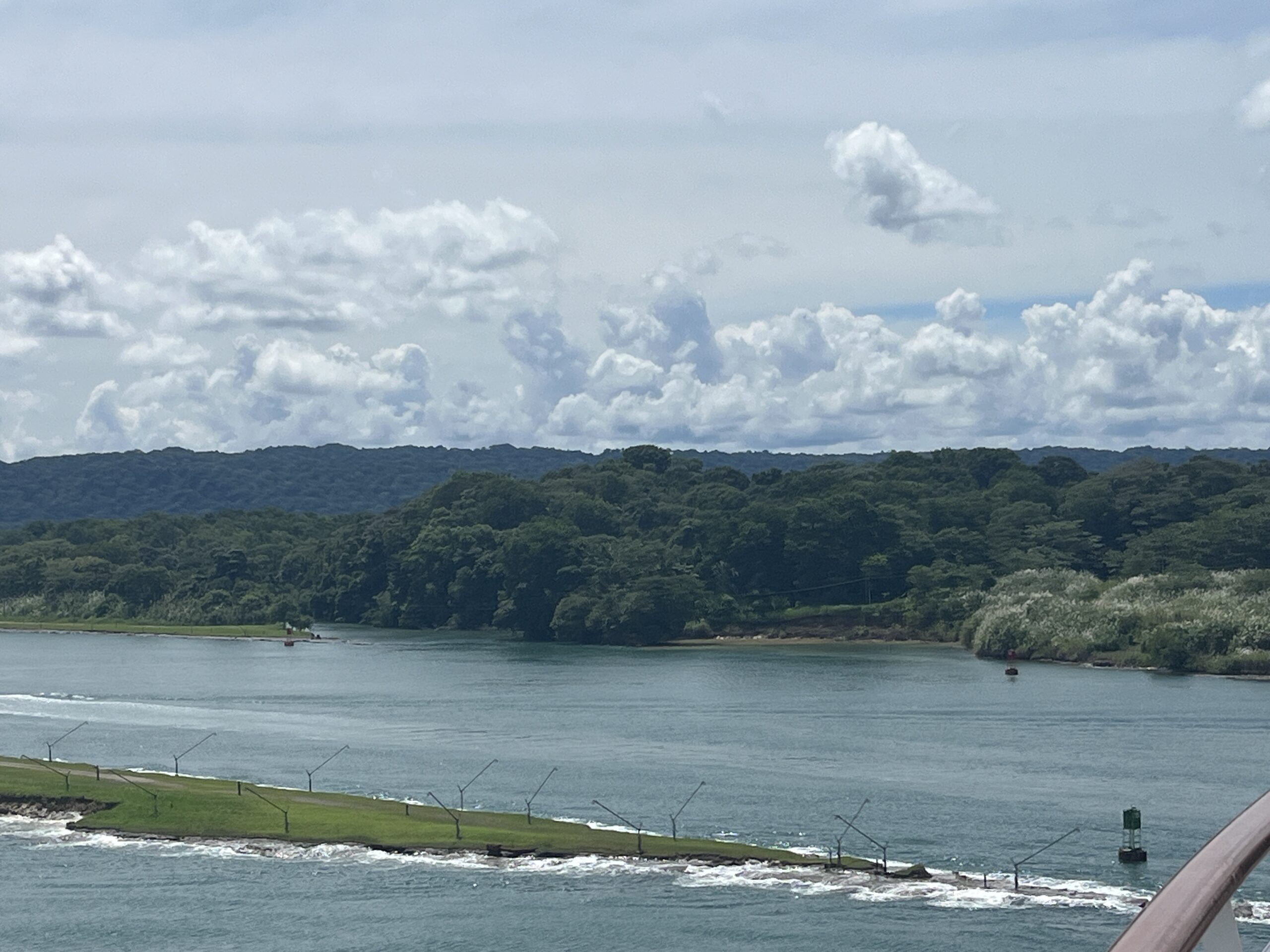
Even today, some remnants of the French work can still be seen along the canal route and is often pointed out as you enter from the Atlantic.
The United States Take Over Construction
The United States stepped in to take over the project in 1904, but with a completely different approach.
Instead of attempting a sea-level canal, American engineers designed a lock canal, which would raise ships up above sea level to cross the country through an artificial lake before lowering them back down again on the other side.
But one of the biggest breaks for construction was nothing mechanical. It was when doctors finally determined that mosquitoes were responsible for spreading malaria and yellow fever. With that discovery, major mosquito control programs were implemented, dramatically reducing disease among workers.
Construction took only 10 years, and the Panama Canal officially opened in 1914, instantly becoming one of the most important shipping routes in the world.
How the Panama Canal Locks Work
The canal works using a series of massive lock chambers that act like giant water elevators for ships.
When a ship enters a lock chamber, enormous gates close behind it. Water is then allowed to flow into the chamber from higher elevations, slowly raising the ship to the next level. Once the chamber reaches the same height as the next section of the canal, the gates ahead open and the ship moves forward.
This process repeats several times until the ship reaches the top elevation of the canal system.

One of the most interesting things you’ll notice during a canal transit in the original locks, are the small electric locomotives that run along rails on both sides of the lock chambers. These are known as “mules.”
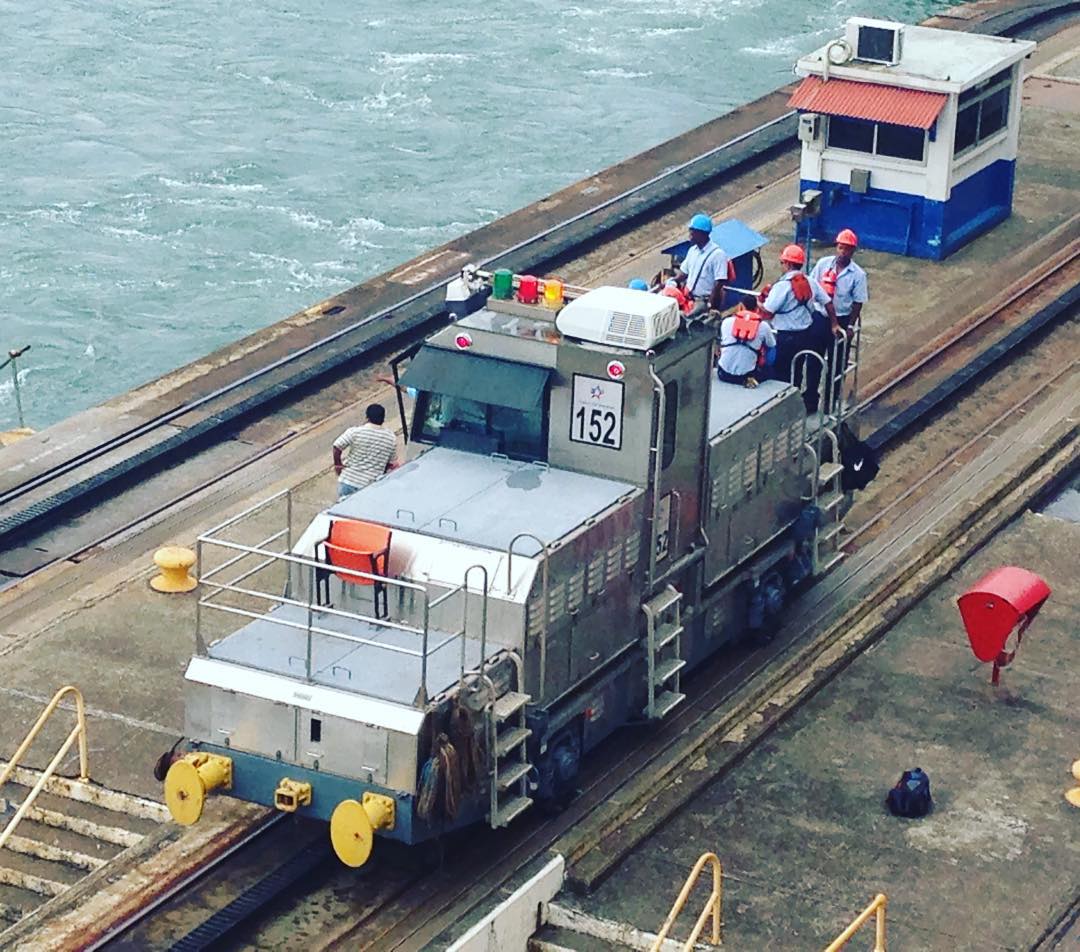
The name dates back to when actual mules were considered to help stabilize ships during the locking process. Today’s mules are electric locomotives that use steel cables attached to the ship to keep it centered in the lock chamber and prevent it from drifting into the concrete walls as the water level changes.
Contrary to what many people think, the mules do not pull the ship through the canal. Ships move under their own power, with the locomotives simply acting as stabilizers to keep the vessel properly aligned inside the chamber. Larger ships can have multiple mules attached on each side, working in coordination to keep everything steady.
The original canal uses three lock systems:
- Gatun Locks on the Atlantic side
- Pedro Miguel Lock
- Miraflores Locks on the Pacific side
Together, these locks raise ships roughly 85 feet above sea level, allowing them to cross Panama through Gatun Lake before descending back down to the Pacific Ocean.

The 2016 Expansion of the Panama Canal
For nearly a century, the canal handled ships built specifically to fit within the dimensions of the original locks. These vessels became known as Panamax ships, because their size was dictated by the maximum width and length that could pass through the canal.
The original lock chambers are about 110 feet wide and roughly 1,000 feet long, which may have seemed enormous when they were built in the early 1900s but eventually became a limitation as ships got bigger and bigger.
Over time, many cargo ships, tankers, and even cruise ships became too wide to fit through those original chambers.
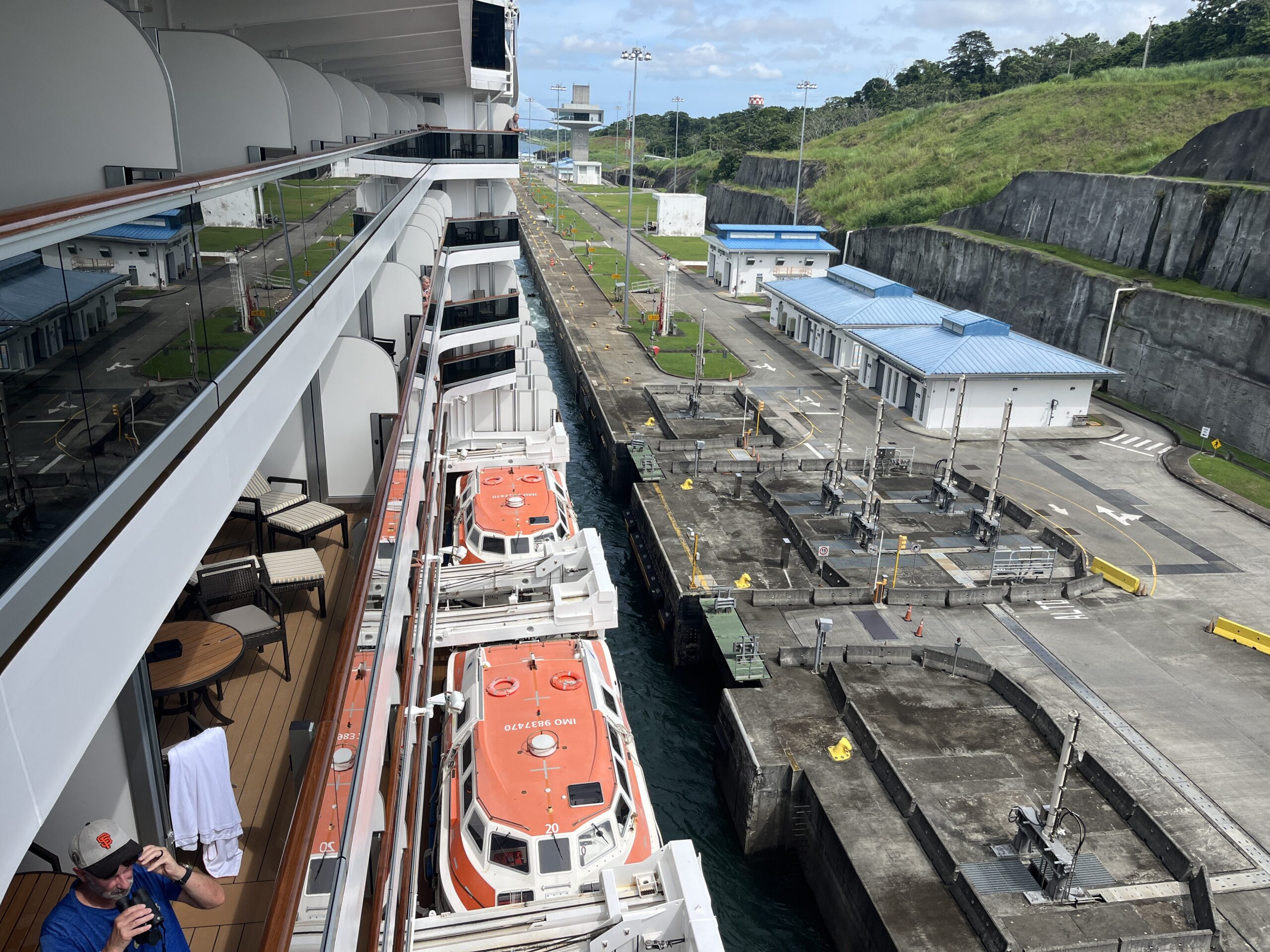
To address this, Panama undertook a massive expansion project that opened in 2016, adding an entirely new set of locks capable of handling much larger vessels.
These new locks include:
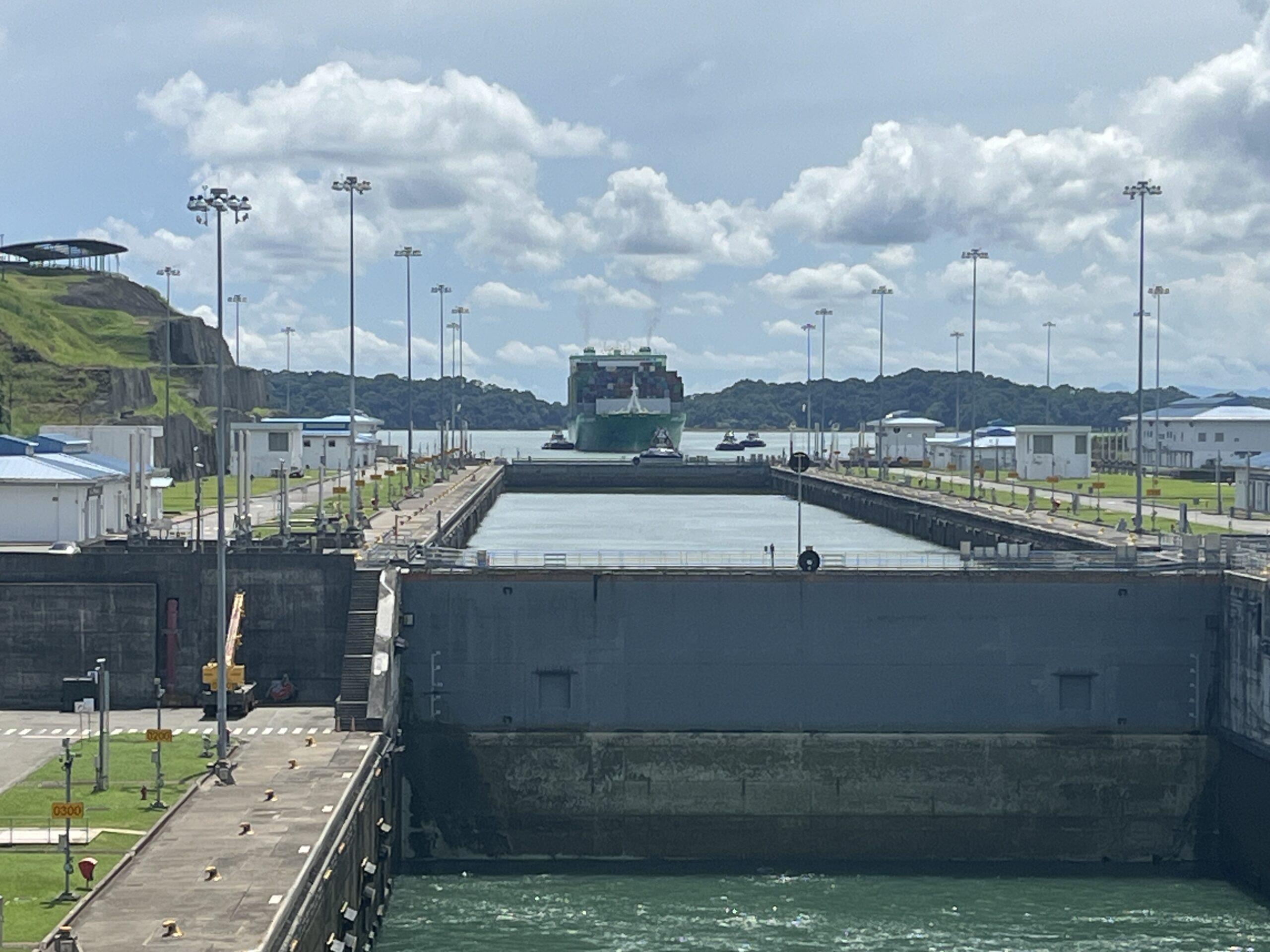
- Agua Clara Locks on the Atlantic side which we’re going through today
- Cocolí Locks on the Pacific side
The new lock chambers measure about 180 feet wide and roughly 1,400 feet long. This allows ships classified as Neopanamax vessels to transit the canal, ships that are significantly wider and longer than traditional Panamax ships.
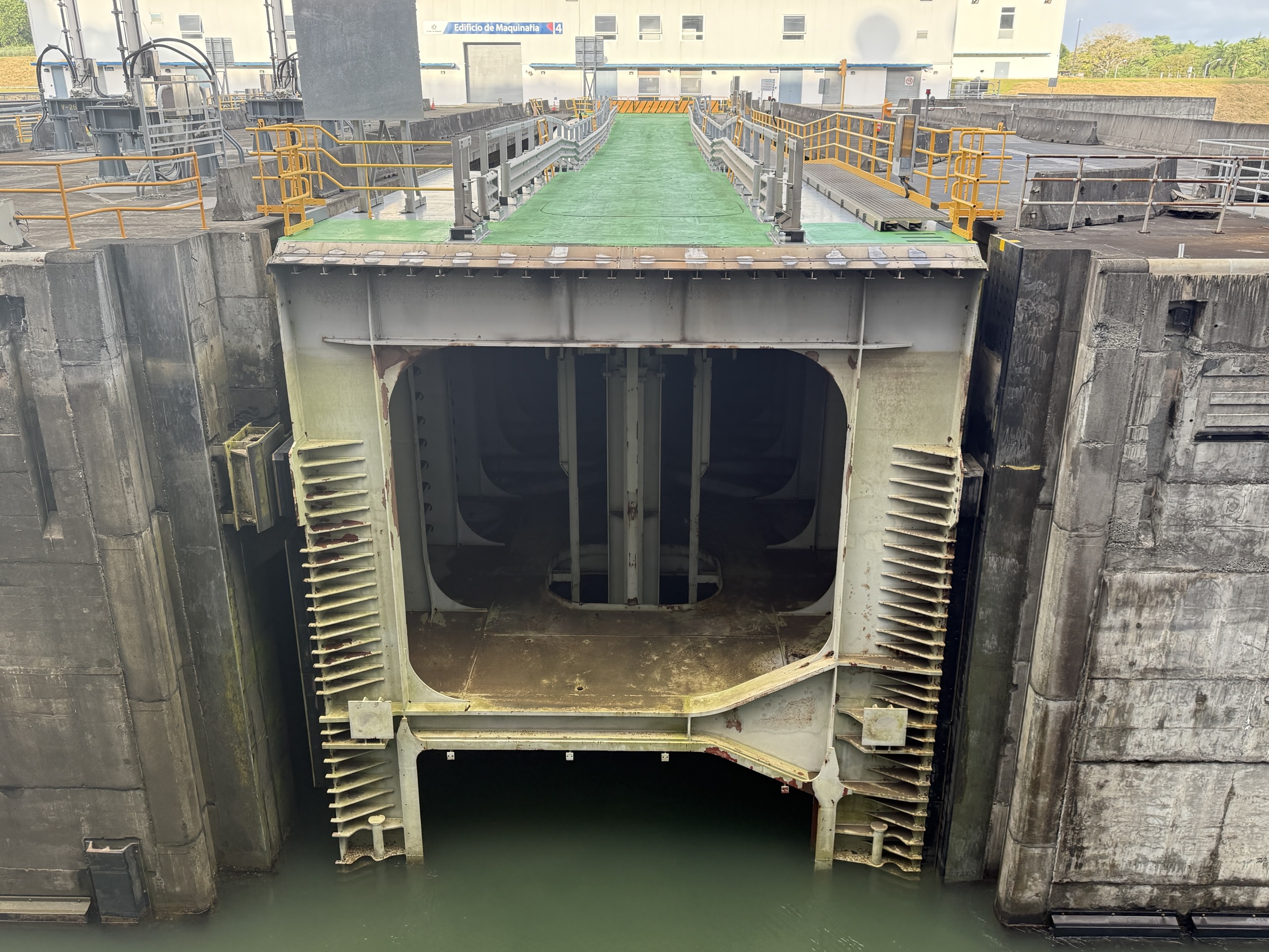


Because of this size difference, ships like Rotterdam simply cannot use the original locks.
The new locks also operate a little differently.
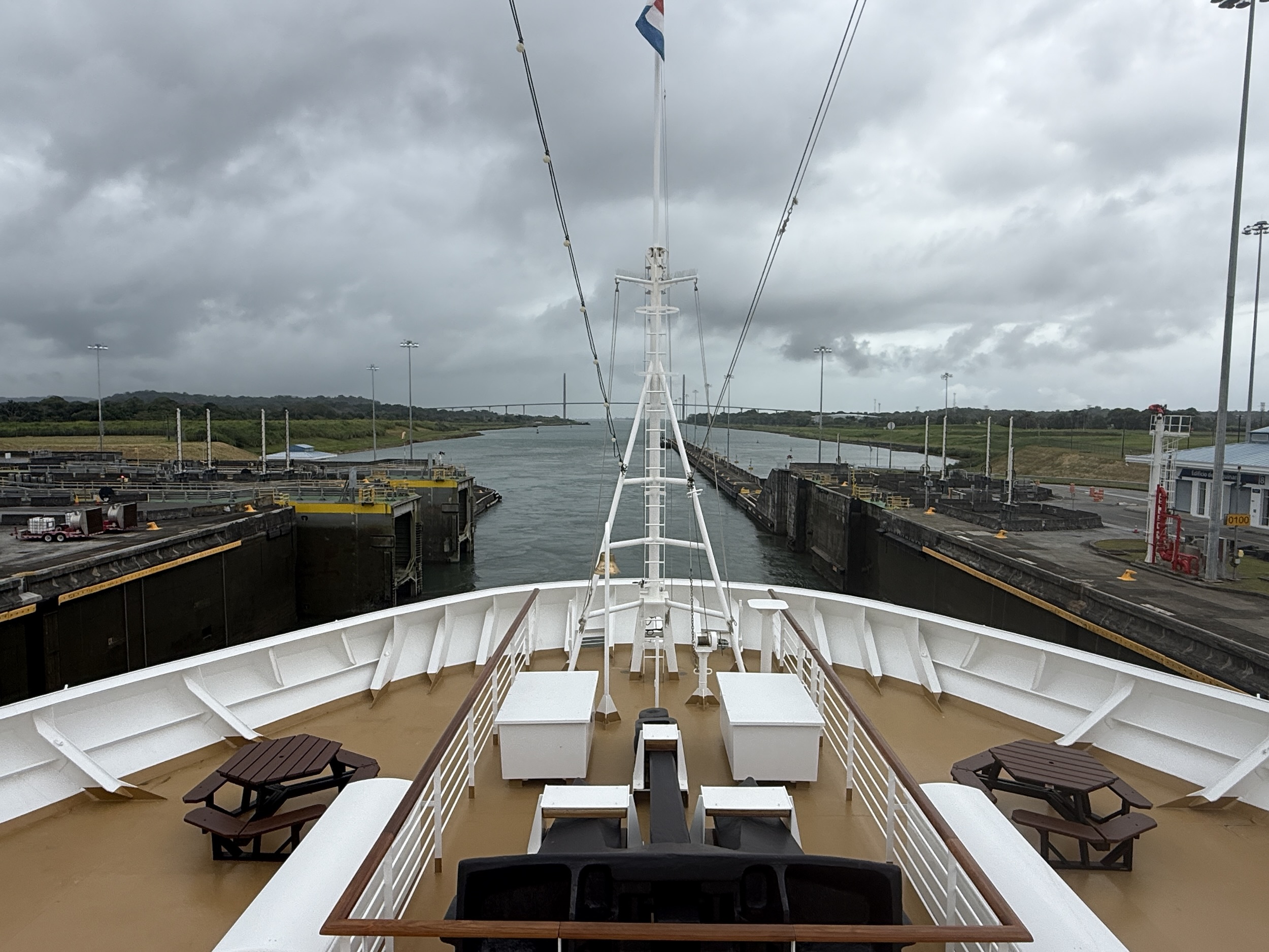
Instead of relying entirely on gravity-fed water from the lake, the new locks use a system of water-saving basins alongside each chamber, visible as you’re going through it. These basins recycle a large portion of the water used during each lock cycle, making the system far more efficient and reducing the amount of freshwater needed from Gatun Lake.

The gates themselves are also different. The original locks use hinged gates that swing open like giant doors, while the new locks use massive rolling steel gates that slide sideways into recessed chambers in the lock walls – like a pocket door.
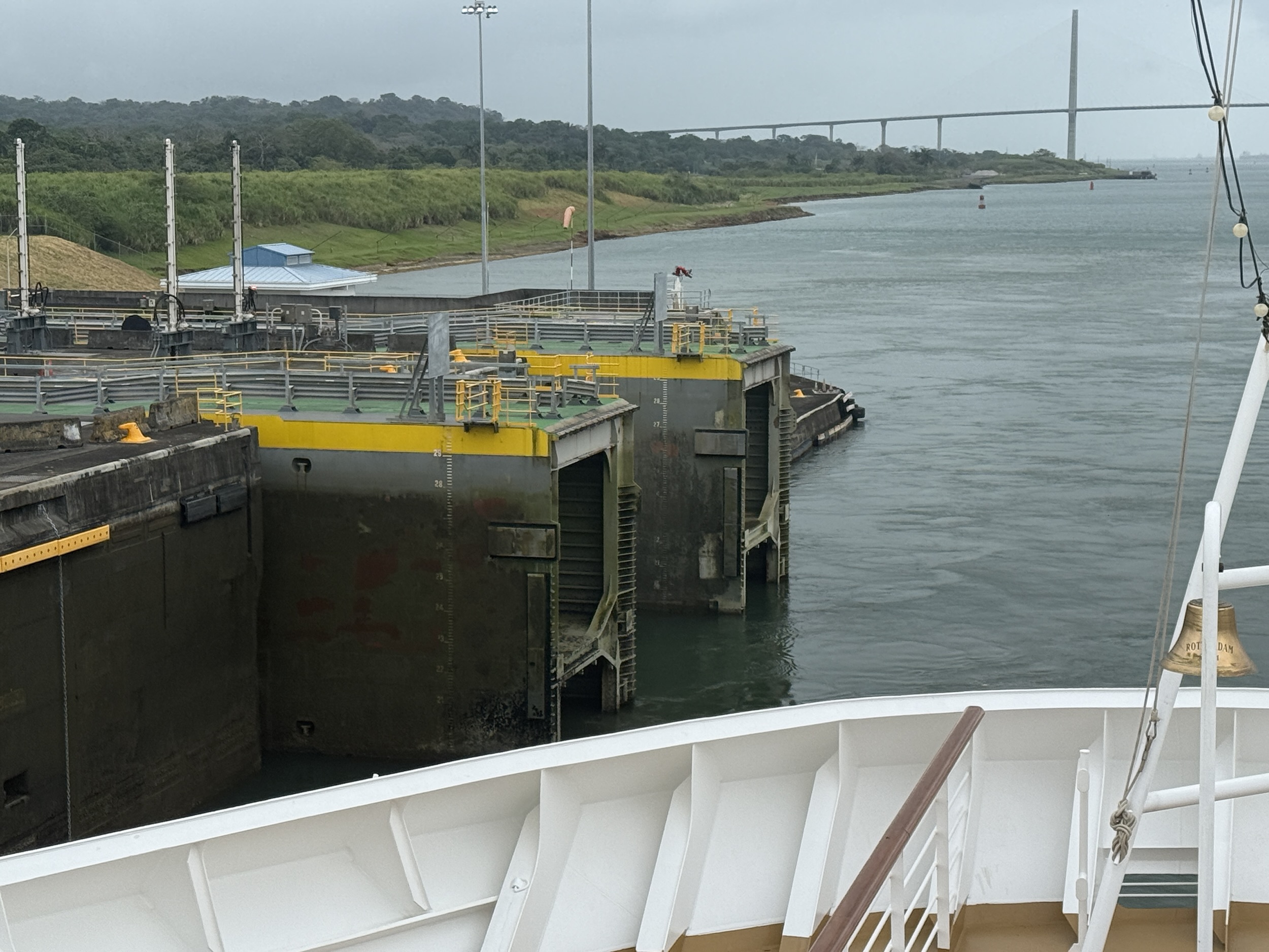
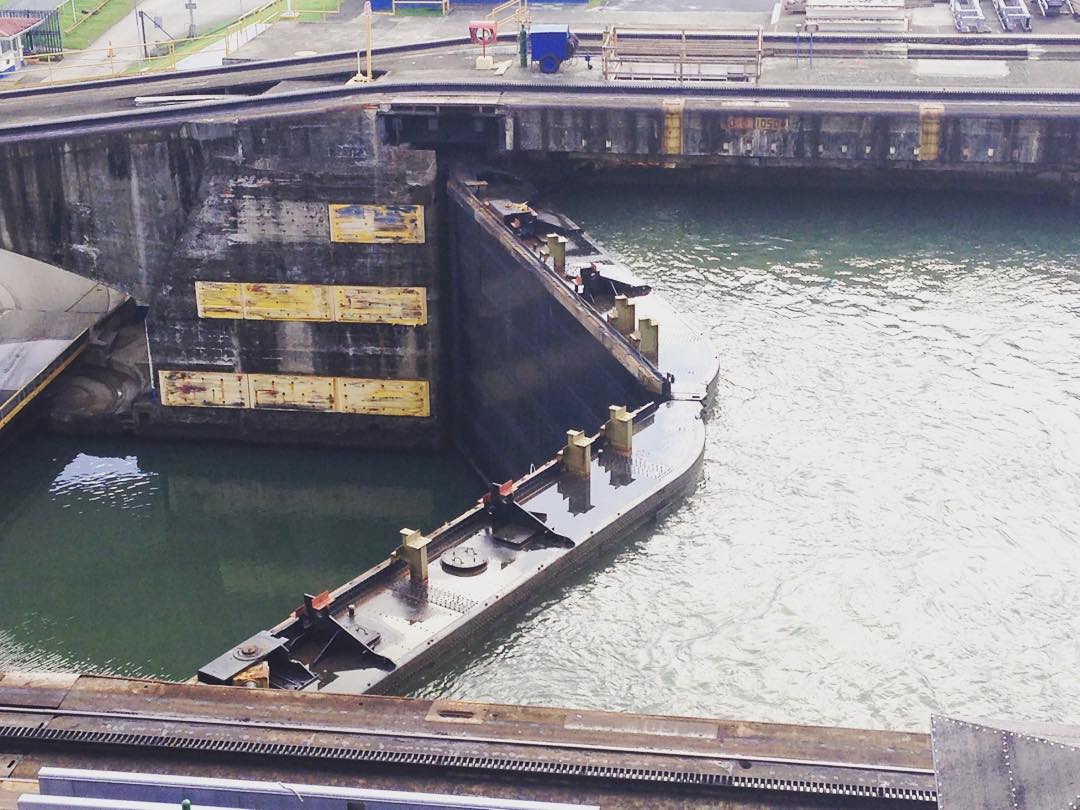
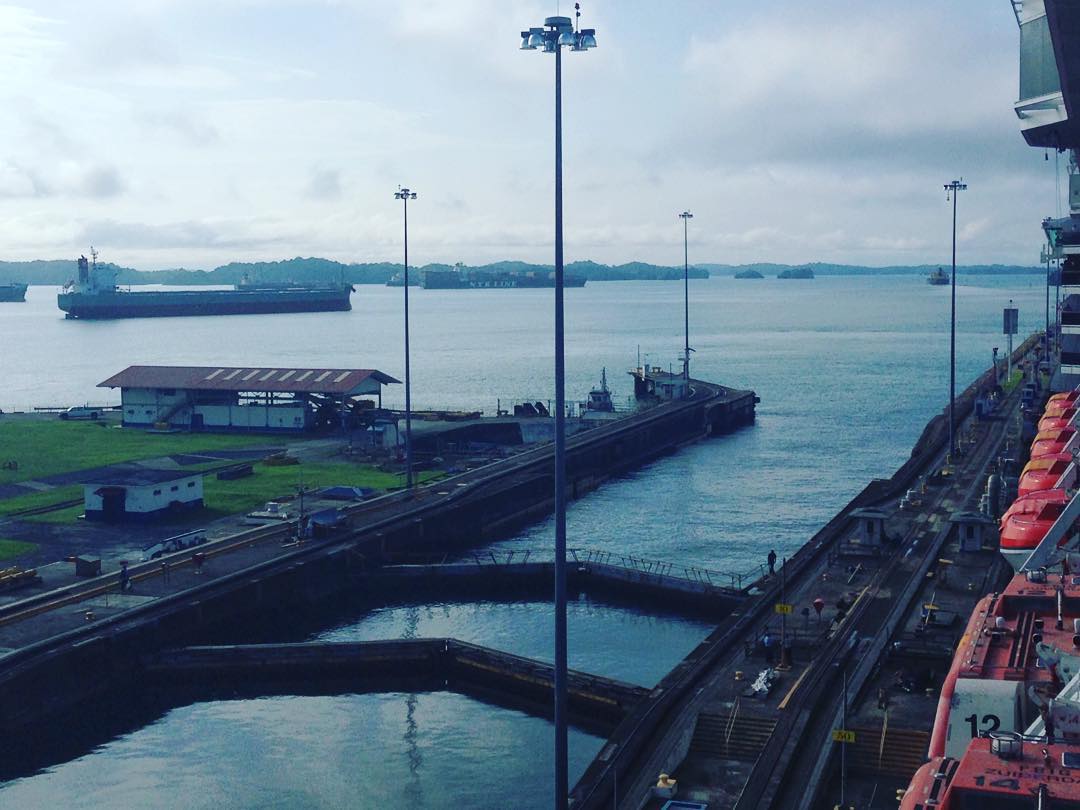
Another major difference is the absence of the mules that guide ships through the original locks.
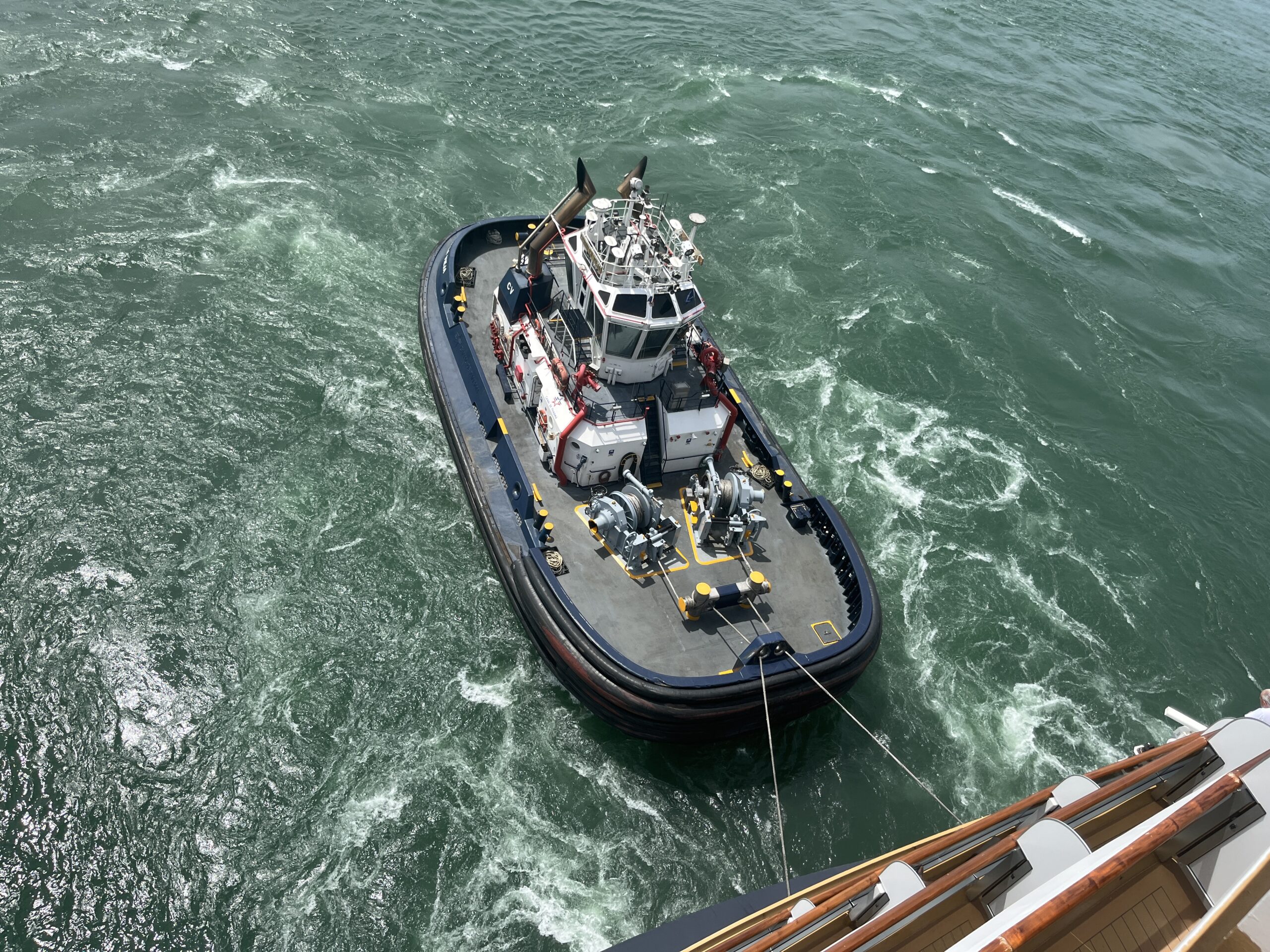
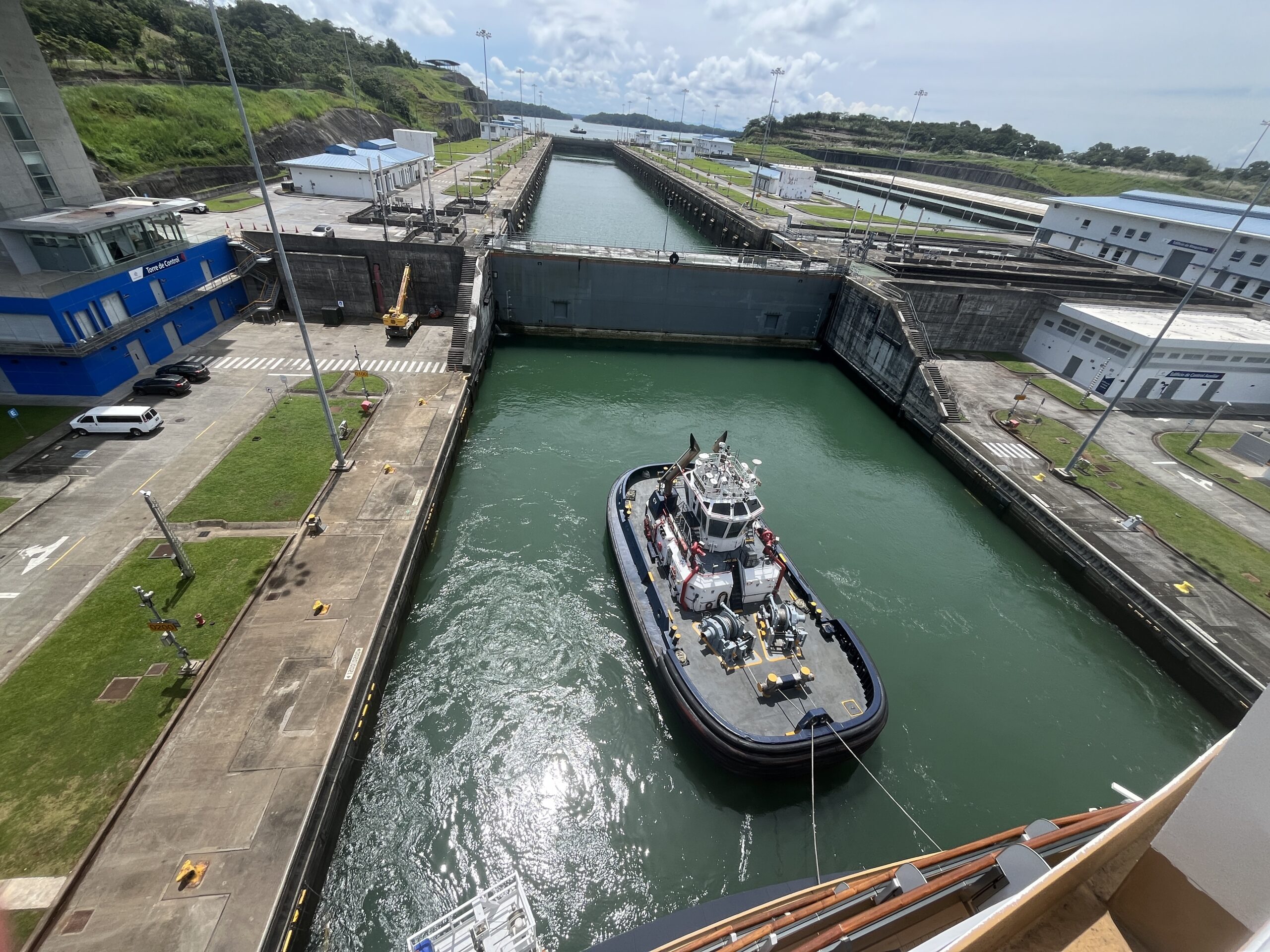
Because the new locks are so much wider, those locomotives are no longer needed. Instead, ships in the new locks are guided using powerful tugboats that maneuver the vessel inside the chamber. These tugs help keep the ship centered and positioned properly as the water level rises or falls. In our case, a tugboat was tied up to Rotterdam at both the front and back of the ship.
Interestingly, the old and new locks sit right next to each other, but because of the canal’s layout and the surrounding terrain, you can’t easily see both systems at the same time while transiting, but if a large ship is going thru the old locks, you may catch a glimpse of the top of it from the new locks.
So while Rotterdam was climbing through the Agua Clara Locks, the original Gatun Locks were operating just nearby, continuing to move smaller Panamax vessels through the canal just as they have for more than a century.
Why Rotterdam Uses the New Locks
Rotterdam, like many modern cruise ships, is simply too wide to fit through the original locks, so it must use the newer Agua Clara Locks on the Atlantic side. Even though there was plenty of clearance on each side of Rotterdam to avoid touching the side of the locks, her lifeboats were “tucked in” as they hang off the side of the ship slightly. In case there was gusty winds or turbulant water, leaving them in that position could subject them to damage, so they were brought in a tad.

Even ships that technically fit the original locks sometimes use the new ones depending on traffic conditions and scheduling, since the canal operates around the clock and ships are constantly moving through in both directions.
The Cost of Transiting the Canal
Passing through the Panama Canal is not cheap.
The Panama Canal Authority collects roughly $8 billion per year in toll revenue, making it one of the most profitable waterways in the world.
For the Rotterdam, the estimated cost for today’s partial transit is around $450,000. Yes, you read that correctly. Nearly a half-million dollars to have us tourists only make a partial transit of the canal!
That’s one of the reasons why Panama Canal cruises tend to have some of the highest port taxes and fees you’ll see when booking a cruise.
Rotterdam’s Early Morning Arrival at the Canal
Onboard Rotterdam, the day started very early.
The ship took on its Panama Canal pilot at 5:30 a.m., which is required for all vessels entering the canal. These specially trained pilots take control of the ship while navigating through the canal system.
Holland America also opened up the forward bow of the ship, which is normally reserved for crew use, giving passengers one of the best viewing spots onboard.
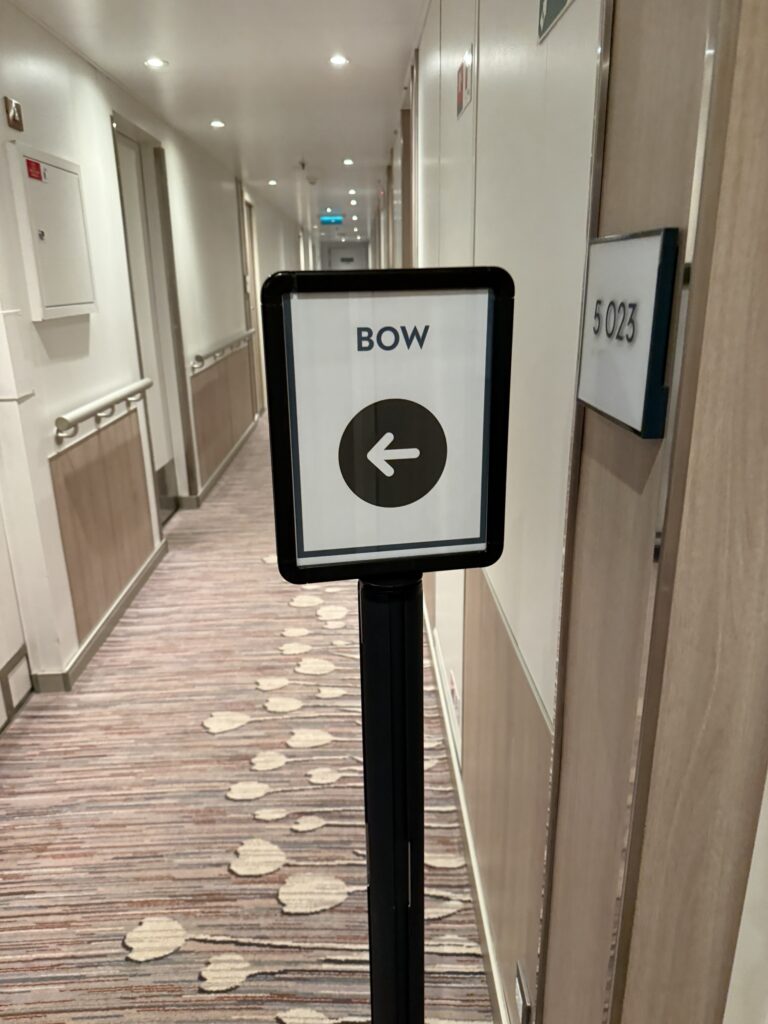


The bow opened at 6:00 a.m., but many guests were already lined up well before that. Some people had reportedly been waiting as early as 4:30 a.m. to secure a prime spot.
Our onboard travel guide began live commentary from the Crow’s Nest, explaining the canal’s history and pointing out landmarks as we approached the locks. The presentation was broadcast throughout the open decks and on the stateroom television channels so everyone could follow along.
At 6:00 a.m., we passed the port of Cristóbal, which sits at the Caribbean entrance to the canal.
Shortly after that we sailed under the equally impressive Atlantic Bridge, a massive bridge that spans the canal near its entrance.
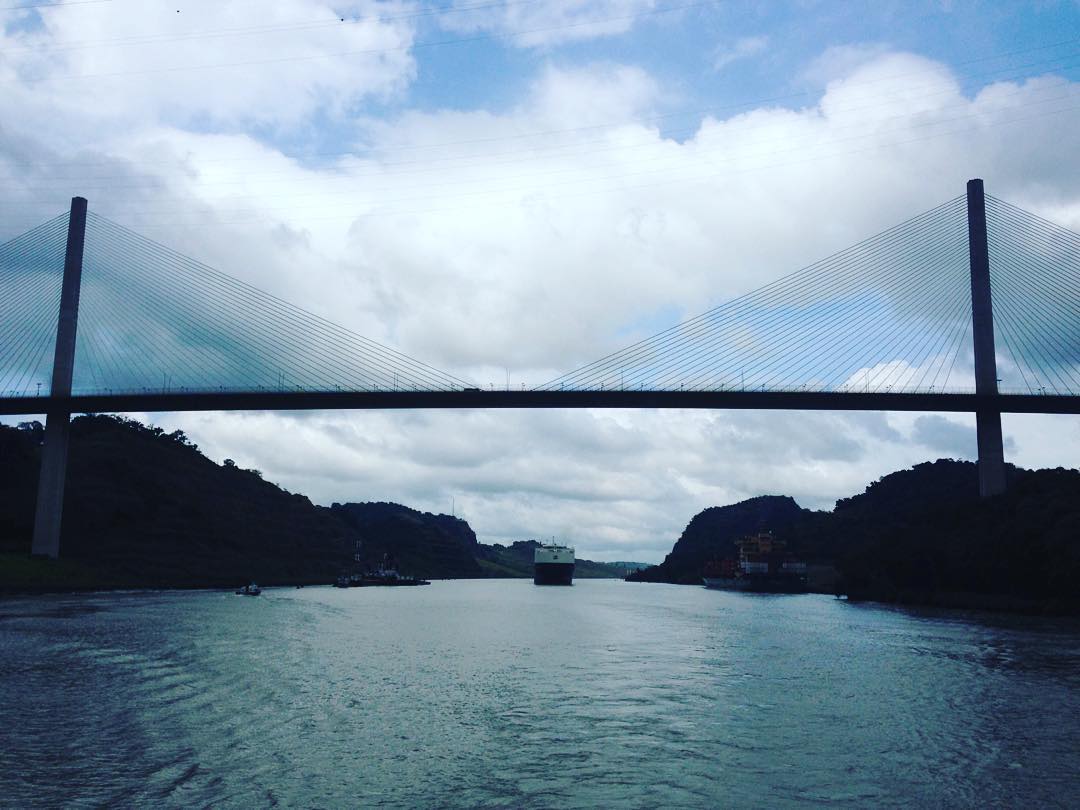
Then at 7:15 a.m., Rotterdam entered the Agua Clara Locks, beginning the process of climbing up toward Gatun Lake.
Over the next 90 minutes, Rotterdam passed through three lock chambers, each raising the ship about 29 feet.

By the time we reached the top of the final chamber, the ship had been lifted 87 feet above sea level, bringing us to the elevation of Gatun Lake.
Watching this process happen is incredible!
The gates close behind the ship, water begins flowing into the chamber from the floor, and slowly the ship rises higher and higher until it reaches the level of the next chamber.
Arriving at Gatun Lake
Once we cleared all three of the Agua Clara locks, Rotterdam entered Gatun Lake, which was once one of the largest man-made lakes in the world.
The lake was created when engineers built the Gatun Dam across the Chagres River by flooding part of a jungle to form a waterway across the center of the country.
The lake serves two purposes:
First, it acts as the main shipping channel across Panama, allowing ships to travel between the Atlantic and Pacific lock systems.
Second, it provides the freshwater used to operate the locks themselves, since each lock cycle requires millions of gallons of water.
Once Rotterdam cleared the locks and entered Gatun Lake, we dropped anchor for a bit.
Guests who had booked Panama Canal shore excursions were taken ashore using the ship’s lifeboats, which acted as tenders for the short ride to a dock along the lake. Once everyone was safely ashore and headed off on their tours, the lifeboats were brought back up and secured, and the ship prepared for the next part of the day.
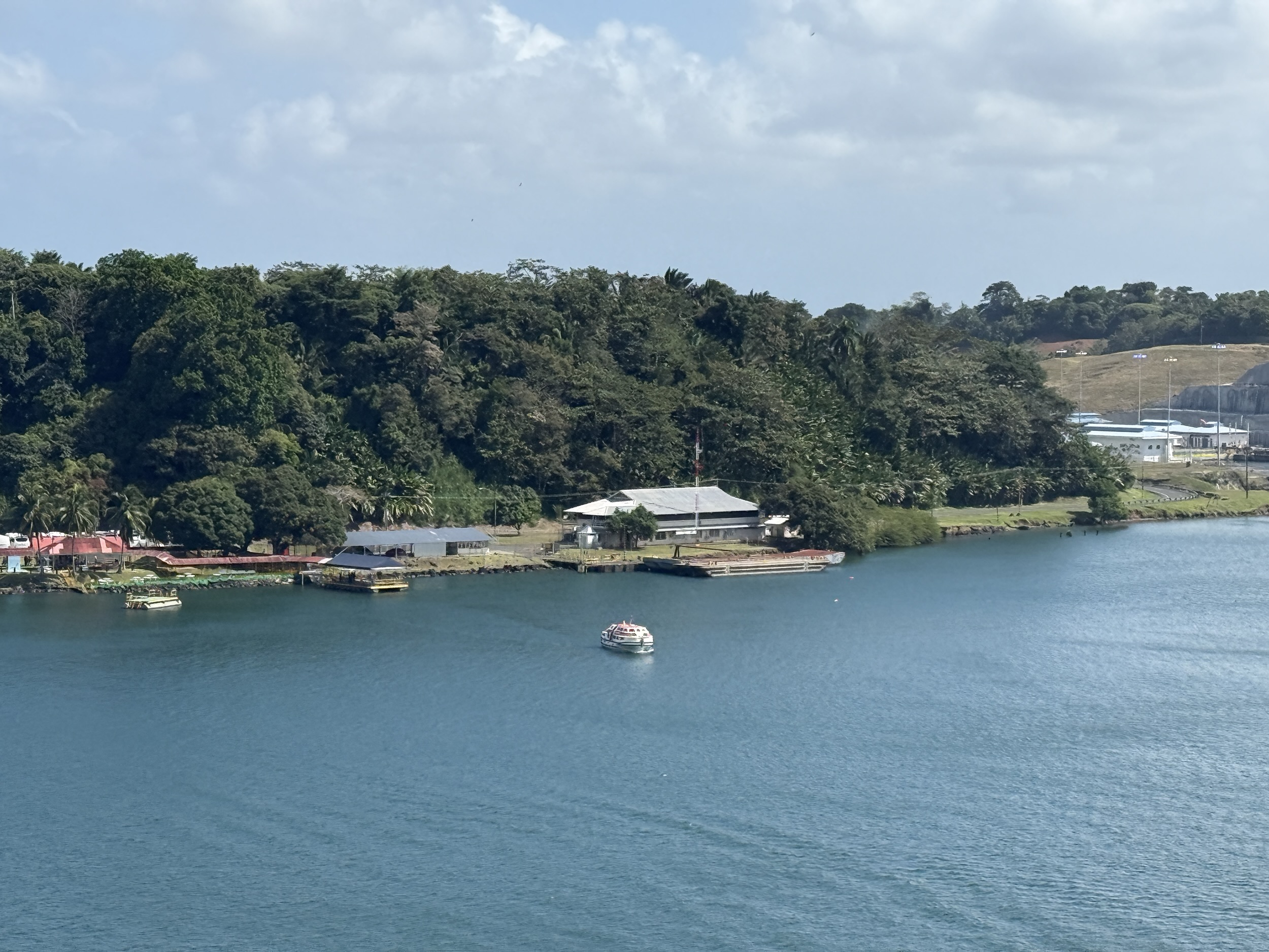
Around 1:15 p.m., Rotterdam began the return trip through the Agua Clara Locks, repeating the process we experienced earlier but in reverse.
This time, instead of being lifted, the ship was lowered through the three lock chambers, dropping 29 feet in each lock until we descended a total of 87 feet, bringing us back down to sea level on the Atlantic side.
Now you might be wondering about the passengers who went ashore earlier in the day.
After exiting the locks around 3:30 p.m., Rotterdam sailed a short distance to Colón, Panama, where we tied up at the pier around 5:00 p.m.
From there, guests were free to go ashore if they wanted, while we waited for those who had been out on canal excursions to return by bus before the ship continued on its journey.

The Canal and the Impact of the Drought
While the Panama Canal has been operating for more than a century, it’s not immune to Mother Nature. One of the biggest issues the canal has faced in recent years has been water shortages caused by drought.
The Panama Canal relies entirely on freshwater to operate. Every time a ship passes through the locks, millions of gallons of water are released from Gatun Lake and the surrounding reservoirs to raise and lower the vessel.
That water ultimately flows out to sea and has to be replaced by rainfall.
When rainfall levels drop, so does the water level in Gatun Lake, which means the canal authority has to carefully manage how much water is used each day. During severe drought conditions, that often leads to reducing the number of ships allowed to transit the canal.
Back in 2023, when Panama was dealing with one of the worst droughts in decades, the canal authority was forced to significantly reduce the number of daily transit slots. The waiting list for ships trying to get through the canal grew longer and longer, and some vessels were waiting days or even weeks for an opening.
For cruise ships operating on tight itineraries, that simply wasn’t workable.
Many cruise lines were canceling Panama Canal transits because they couldn’t secure a guaranteed transit slot.
On my last cruise through here in 2023, also aboard Rotterdam, we were lucky enough to still be allowed into the canal. However, once we reached Gatun Lake, we didn’t get the same experience we had today.
Instead of anchoring and sending guests ashore for excursions like we did on this trip, the ship was required to immediately turn around and head back out through the locks.
All of the shore excursions that had been planned for the day were canceled, largely because the canal authority was trying to get as many ships through as quickly as possible because of the backlog of vessels.
Thankfully, rainfall levels have improved since then and canal operations have been able to return to normal.
Time-Lapse Panama Canal Transit
Check out this time-lapse video I took from the bow of the Rotterdam as we made our way from Gatun Lake to the Atlantic Ocean.
A Quick Stop in Colón, Panama
After exiting the locks and making our way back down to sea level, Rotterdam sailed a short distance to Colón, Panama, arriving at the pier around 5:00 p.m.
The stop here serves two purposes. First, it allows the ship to pick up the guests who had gone ashore earlier in the day for Panama Canal excursions. Second, it gives passengers onboard a little time to step ashore and stretch their legs while we wait for everyone to return.
Now let’s talk honestly about Colón.
Unlike many cruise ports where you can easily wander into town and explore on your own, Colón is not one of those places.
The port itself is a secured area, which includes a small two-level shopping complex with stores, a few duty-free shops, and some places where you can grab drinks or snacks. There’s also a small duty-free zone nearby known as the Colón Free Zone, which is one of the largest free-trade zones in the world, although it’s more of a wholesale commercial area than something designed for tourists.
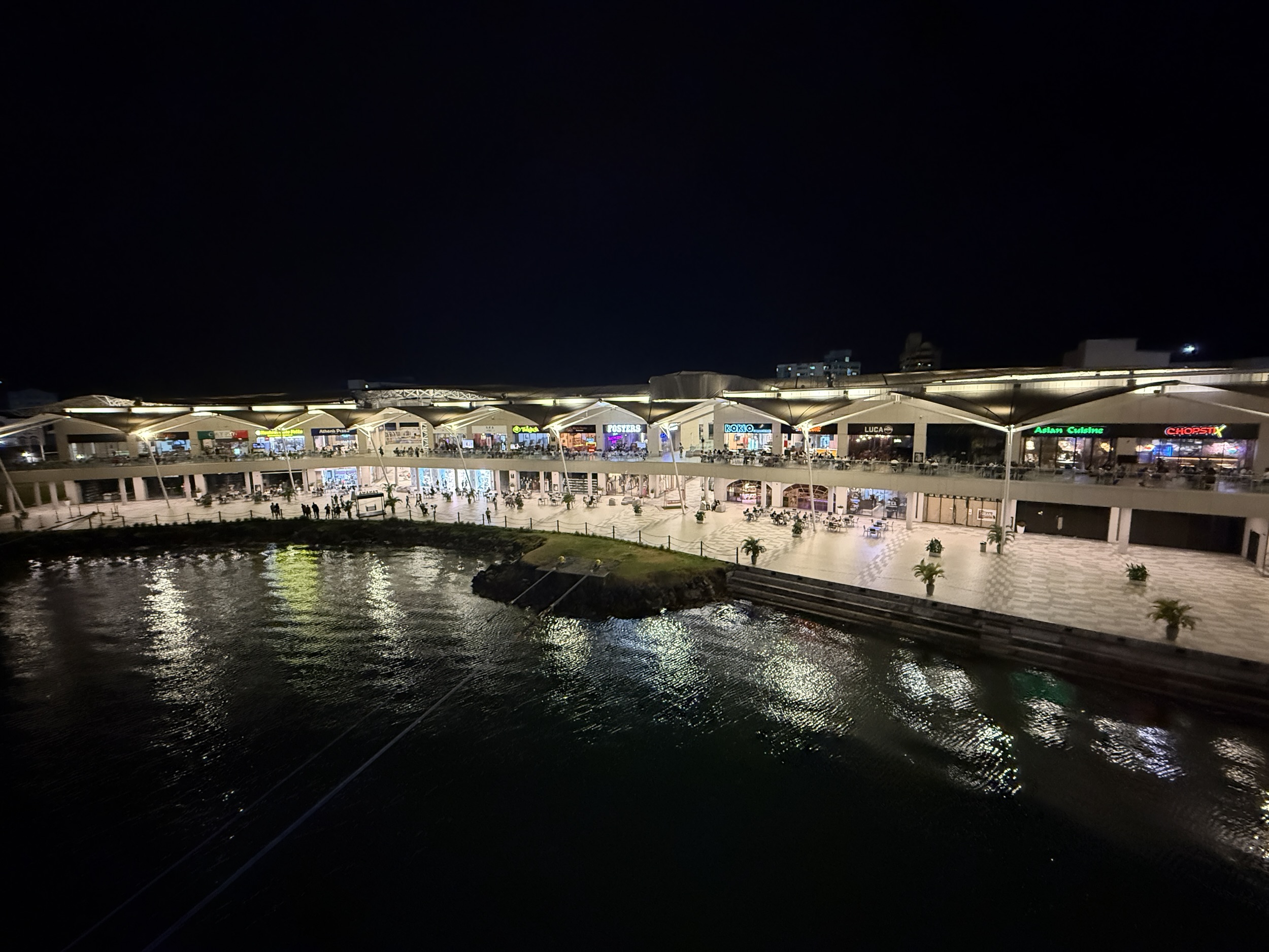
But once you step outside the secure port area, things change pretty quickly.
Colón unfortunately has a reputation for being one of, if not, the roughest cities in Panama, and it’s not considered safe for tourists to wander around on their own. Crime levels in certain parts of the city can be high, and cruise lines typically advise guests to stick within the secure port complex. With Rotterdam arrive just before sundown and with darkness approaching, I didn’t even step off the ship.
There’s not really a traditional tourist district within walking distance of the pier, and the surrounding neighborhoods aren’t places most visitors would feel comfortable exploring.
Because of that, most passengers who get off the ship here either browse the small port shopping area for a few minutes or simply stay onboard while waiting for the excursion buses to return.
Colón is generally more of a functional stop than a destination. It’s really just a convenient place for ships to regroup after Panama Canal excursions before continuing on with the cruise.
Dinner at Tamarind
Once everyone was back onboard and accounted for, Rotterdam pulled away from Colón around 7:45 p.m., beginning the next leg of the journey as we set course toward Puerto Limón, Costa Rica.
Around that same time I settled in at my usual perch, the Half Moon Bar, for a quick cocktail before heading off to dinner.
Tonight’s dinner destination was Tamarind, Holland America’s pan-Asian specialty restaurant onboard.
But before getting there, here’s a look at what was being served tonight in the Lido Market and the main dining room, which happened to be featuring a Panamanian-themed menu to mark our day in the canal.
Holland America Lido Market Dinner Menu Night 8
Menu from Rotterdam, March 2026

Available on: all ships
Holland America Main Dining Room Dinner Menu Night 8
Menu from Rotterdam, March 2026
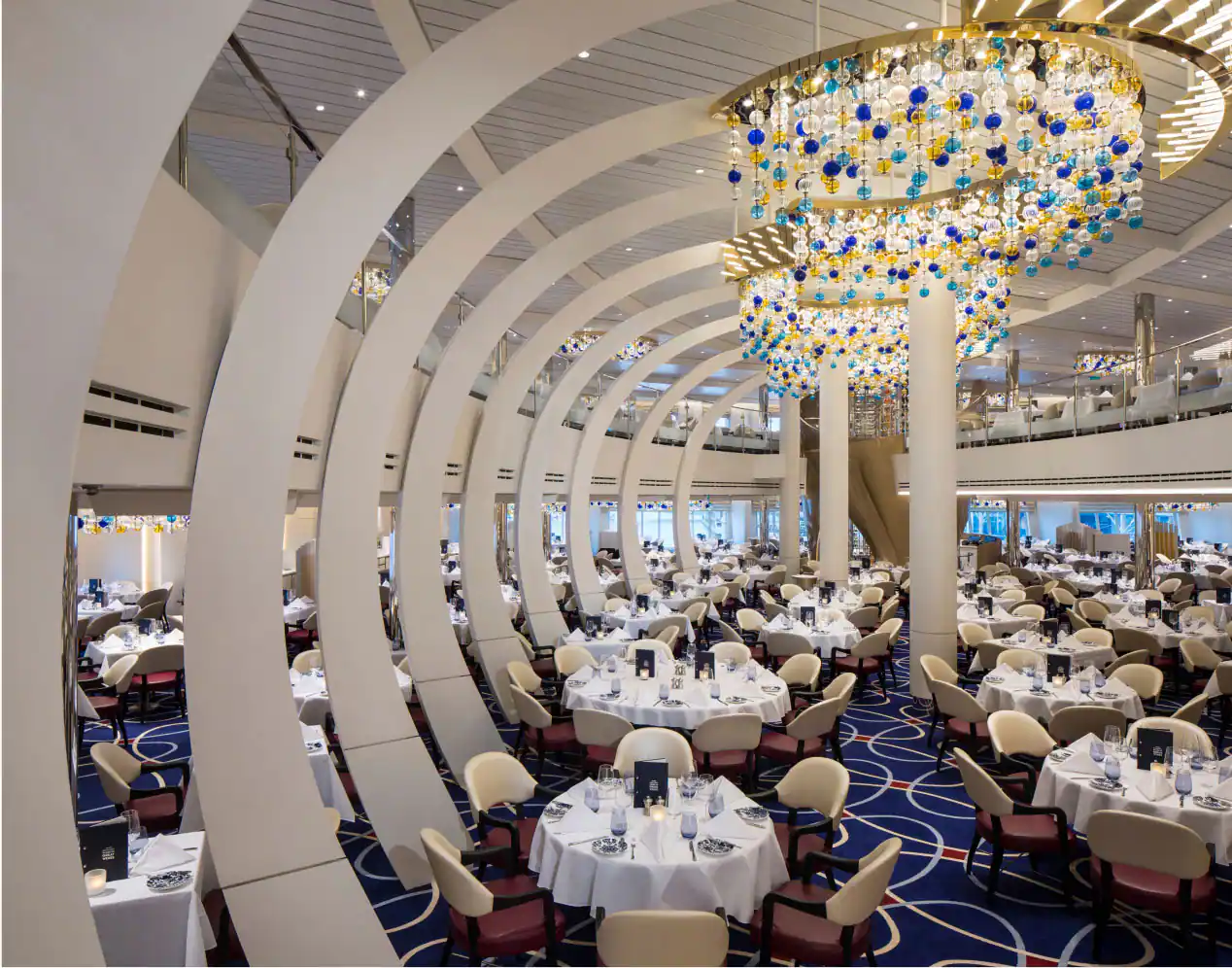
Available on: all ships
Tamarind is located all the way aft on Deck 10, overlooking the Sea View Pool. It’s a darker, more intimate space compared to many of the other restaurants onboard, and it includes a small sushi bar, a regular cocktail bar, and the main dining room.
I didn’t have a reservation tonight, but when I arrived it wasn’t particularly busy. Ann, the host, quickly found me a table with a nice view overlooking the pool.
To start things off I ordered a spicy tuna roll from the sushi bar, which is available à la carte, along with several small bar bites listed on the sushi menu.
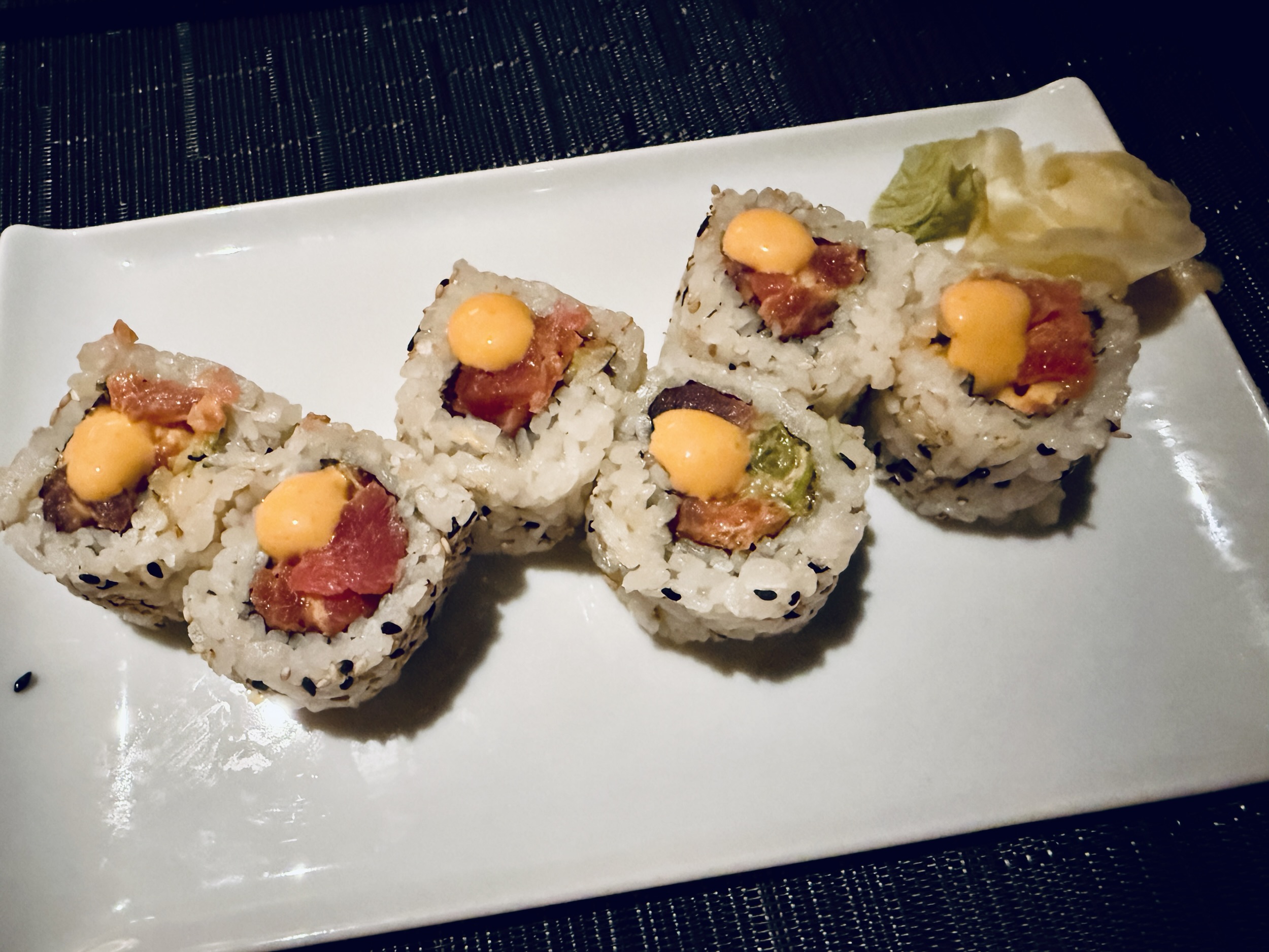
All of the sushi I’ve had either here at Tamarind or from the Lido Market sushi station has been consistently fresh and delicious, and tonight was no exception.
Honestly, I don’t think I’ve eaten as much sushi anywhere, either at home or on a cruise ship, as I have on Holland America ships.
Next up were the Korean beef bulgogi tacos, which come two to an order. These were… fine. Not bad, but also nothing particularly memorable.

The pork bao buns followed, and if we’re being completely honest with each other, there was definitely more bun than there was pork.

So the sushi clearly won the starter round tonight.
For the main course I went with the wasabi and soy-crusted beef tenderloin, cooked medium rare.

At $35 per person, Tamarind is reasonably priced for a specialty restaurant, and while the tenderloin here isn’t quite the same size as what you’d get over at Pinnacle Grill, it was still perfectly cooked, tender, and packed with flavor.
I paired it with a side of fried rice and sautéed mushrooms, which made for a really satisfying plate.
Needless to say, there was no room left for dessert.
Tamarind has always been one of my favorite restaurants on Holland America ships, and tonight’s meal and service definitely reaffirmed that opinion.
One Quick Entertainment Note
One quick thing before wrapping up this report.
Tonight’s main entertainment in the theater was comedy magician John Accardo. I didn’t catch the entire show, but I did pop in for a few minutes while making my usual rounds around the ship.
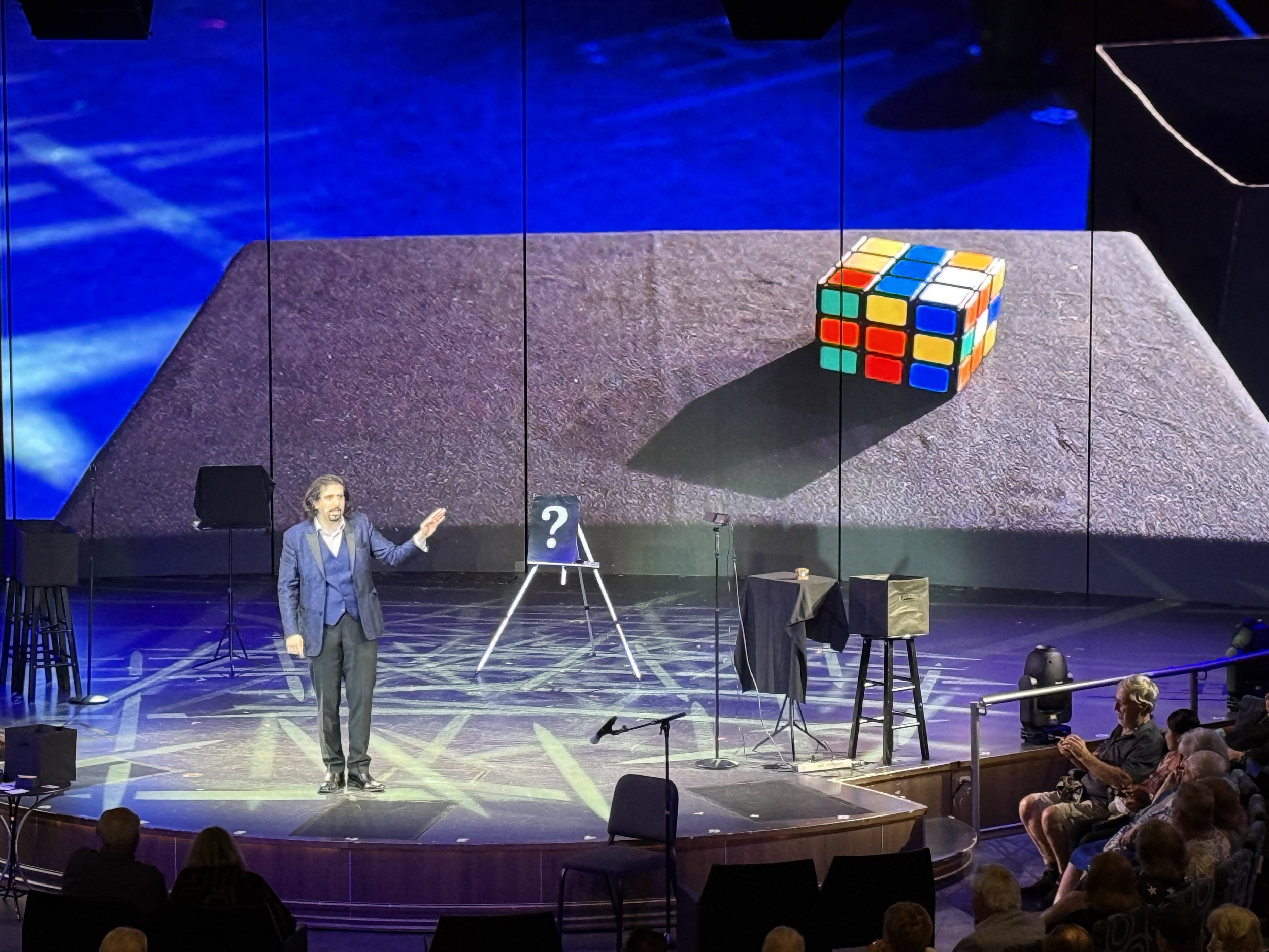
Unfortunately, the exact moment I walked in happened to be during a Rubik’s Cube routine.
And the second I saw that cube come out, I was immediately thrown back to 2023, when I did another Panama Canal cruise on this very same ship. On that sailing the headliner was an entertainer named Tom Crosbie, whose act included a full 45-minute Rubik’s Cube show.

Yes. Forty-five minutes.
And let me tell you… those were 45 very painful minutes.
So imagine my surprise when I wandered into the theater tonight and saw yet another entertainer on the same ship, on the same cruise route, doing a Rubik’s Cube routine.
What are the odds?
And if I’m being honest… it was equally as boring.
Tomorrow morning we arrive in Puerto Limón, Costa Rica, where we’re scheduled to dock at 8:00 a.m. for a full day ashore.
More on that tomorrow, and as always… thanks for following along.
Daily Schedule
| Time | Event | Location |
|---|---|---|
| 6:00 AM | Scenic Cruising Agua Clara Locks | Crow’s Nest (Deck 12) |
| 7:00 AM | Stretch & Release | Fitness Center (Deck 9) |
| 7:00 AM | Panama Canal Photo Opportunity until 3:00 PM | Bow (Deck 5) |
| 8:00 AM | Great Panama Deck Sale | Lido Poolside (Deck 9) |
| 8:00 AM | Morning Catholic Prayer | Half Moon Room (Deck 1) |
| 8:30 AM | Tour de Cycle $20 | Fitness Center (Deck 9) |
| 9:00 AM | Interdenominational Service | Half Moon Room (Deck 1) |
| 9:30 AM | The Greenhouse Spa Wellness Extravaganza | Lido Poolside (Deck 9) |
| 9:30 AM | Complimentary Footprint Analysis | Fitness Center (Deck 9) |
| 10:00 AM | Marbella Mimosa Mornings with EFFY | EFFY Jewelry (Deck 2) |
| 10:00 AM | Party Bridge Play until 12:00 PM | Hudson Room (Deck 1) |
| 10:00 AM | Meet for a Game of Mahjong until 3:00 PM | Half Moon Room (Deck 1) |
| 10:30 AM | Board Game Meetup | Game Room (Deck 12) |
| 10:30 AM | Complimentary Walk-in Medi-Spa Clinic | Greenhouse Spa (Deck 9) |
| 10:30 AM | Find the Perfect Gift for Her | EFFY Jewelry (Deck 2) |
| 11:00 AM | Great Panama Sale continues | Lido Poolside (Deck 9) |
| 11:30 AM | Cocktails with Nick Featuring Fanella Officers of Rotterdam | World Stage (Decks 2 & 3) |
| 12:00 PM | Cricket Sleep Seminar | The Shops (Deck 2) |
| 12:00 PM | Guess the Weight of the Sculpture | Atrium (Deck 2) |
| 12:30 PM | Great Panama Deck Sale continues | Lido Poolside (Deck 9) |
| 12:30 PM | Board Game Meetup | Game Room (Deck 12) |
| 1:00 PM | Swim Across the Panama Canal | Lido Pool (Deck 9) |
| 1:30 PM | Watercoloring: Jelly Fish | Game Room (Deck 12) |
| 2:00 PM | Basketball Knockout | Sport Court (Deck 11) |
| 2:00 PM | Cocktails with Nick Featuring Fanella Officers of Rotterdam | World Stage (Decks 2 & 3) |
| 2:00 PM | Great Panama Deck Sale continues | Lido Poolside (Deck 9) |
| 2:00 PM | Cricket Sleep Seminar | The Shops (Deck 2) |
| 2:00 PM | Guess the Weight of the Sculpture | Atrium (Deck 2) |
| 3:00 PM | Friends of Bill W. Meet | Stuyvesant Room (Deck 1) |
| 3:00 PM | EFFY Jewelry Auction Preview | EFFY Jewelry (Deck 2) |
| 3:00 PM | Walking in Comfort | Fitness Center (Deck 9) |
| 3:30 PM | Coloring for Adults | Game Room (Deck 12) |
| 4:00 PM | Sip & Paint $30 | Art Studio (Deck 1) |
| 4:00 PM | Team Trivia Challenge | Billboard Onboard (Deck 2) |
| 4:00 PM | Origami Folding: Sailboat & Cruise Ship | Game Room (Deck 12) |
| 4:30 PM | Have Your Casual Portrait Taken | Atrium (Deck 2) |
| 5:00 PM | Ask Your Travel Guide Holly | Pier Ashore |
| 5:00 PM | A Pickup Game of Pickleball | Sport Court (Deck 11) |
| 6:00 PM | PRIDE Meetup | Rolling Stone Lounge (Deck 2) |
| 6:30 PM | Singles & Solo Travelers Meetup | Billboard Onboard (Deck 2) |
| 7:00 PM | On World Stage: Song & Dance | World Stage (Decks 2 & 3) |
| 7:30 PM | Game Show: Tone Deaf B.B. King’s Blues Club | B.B. King’s Blues Club (Deck 2) |
| 7:30 PM | Ladies Night in the Thermal Suite $49 | Greenhouse Spa (Deck 9) |
| 7:45 PM | Live Music Trivia: Colors | Billboard Onboard (Deck 2) |
| 8:00 PM | Movies by the Pool: Panamania | Lido Poolside (Deck 9) |
| 8:30 PM | On World Stage: Song & Dance | World Stage (Decks 2 & 3) |
| 9:00 PM | On World Stage: Song & Dance | World Stage (Decks 2 & 3) |
| 9:30 PM | Fragrance Finds from $39.99 | The Shops (Deck 2) |
| 11:00 PM | Over $615,000 Paradise Lotto Jackpot Drawing | Casino (Deck 3) |